Fin
Gente que viene y ¡Bah!Fin, whose full name is Serafín, is Irene’s fifteen-year-old son: an exceptional motocross rider whose confidence on a bike contrasts with a growing, consuming fear of death. That contrast makes him more than the family’s young champion. His questions unsettle the adults’ ordinary celebrations, while a serious race crash brings the danger he has been imagining into sudden, concrete focus.
Identity and Background
Fin is introduced as a teenager already known for extraordinary ability on a motorcycle. He began riding at six, has won extensively, and is described as a natural whose years of effort have helped make him a champion. At a family meal, his modest response to a question about his results shows that achievement has not made him boastful. The family calls him Fin, although his given name is Serafín; Bea privately finds the shortened name too final-sounding, an uneasy association that gains force as the story reveals his preoccupation with mortality.
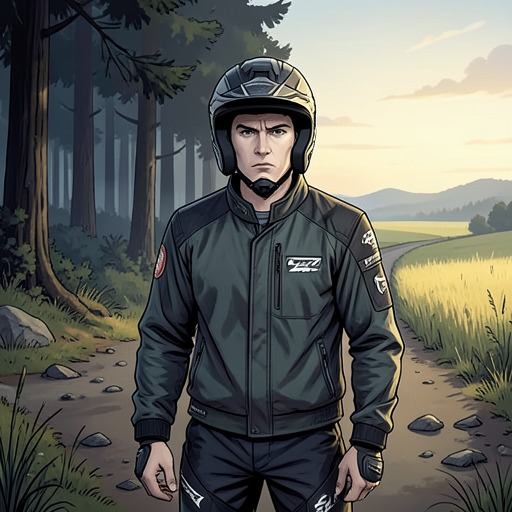
Motocross is not simply a hobby. Fin devotes substantial time and discipline to becoming the best, and his skill is visible even away from a formal race. When he rides along forest tracks, his speed and precision let him fly over mounds and stop abruptly in front of the family. The spectacle is so effortless that he apologizes for arriving late as if nothing remarkable has happened. His physical command of the bike gives the family a vivid image of a young person who seems entirely at home in motion.
Racing and Family Support
Fin’s parents disagree about the risks and demands of his sport. His father, Román, has never liked the motocross: he considers it dangerous and believes that the time and discipline it requires are too much for someone so young. He would rather see Fin spend time with friends or play video games. Irene takes the opposite view. Seeing how happy her son is on the bike, she supports his commitment, reasoning that a passion capable of absorbing him so fully should not be taken away. Her support is not based on indifference to danger; she believes that wanting to excel necessarily costs effort, and she sees his dedication as worthwhile.
That confidence becomes less certain when Fin develops doubts about competing. At the forest track, Bea asks whether he is thinking of leaving the sport, adding that watching him ride makes her proud and that he seems born for it. Her admiration reinforces the family’s established picture of him as a gifted racer, but the question also makes clear that his commitment is no longer unquestioned. The adults’ encouragement cannot by itself settle what he wants, particularly when his thoughts have become fixed on how brief life may be.
Existential Anxiety
Fin’s fear emerges starkly at his grandmother’s sixty-fifth birthday. While the family celebrates with a cake and a single candle, he sighs and says that the age itself is troubling. He then asks his grandmother how she can be happy when she has so little life left. The question abruptly changes the mood: what the family intended as a birthday celebration becomes a confrontation with the fact of mortality. Irene explains that her son has been reading Sartre and has become an existentialist, preoccupied with death wherever he looks. Bea, alarmed by the effect of his question on their mother, responds with irritation, while Fin presses the larger problem: why celebrate another year if it brings everyone closer to death?
The concern is not a passing provocation or a pose adopted for the occasion. Irene says that Fin wakes from nightmares and sometimes cannot sleep because he is distressed by the idea that people come from nothing and return to nothing, leaving life as an absurd and meaningless interval. She is exasperated by the intensity of his anguish, especially because she remembers how happy he was with motocross. She had expected the ordinary worries of parenting a teenager, but not to find him consumed by existential questions.
The family searches for practical ways to interrupt the spiral. Irene considers psychological help, but Fin refuses because no psychologist can guarantee that he will not die. She even wonders aloud whether his nickname contributes to the fixation: Fin sounds like an ending, whereas Serafín is his full name. Her speculation does not establish a cause, but it reveals how closely the family has begun to connect his chosen everyday name with the fear he cannot escape. In another incident, he returns with a black eye after insisting on reading a deeply bleak passage from Sartre to a group of people. His ideas are no longer confined to private worry; he carries them into encounters with others, sometimes at a cost.
Irene suggests that work outdoors might occupy him, and the family considers asking him to help with the house. The proposal is an attempt to give him activity and company rather than an answer to his fear. His days are already divided between school and motocross, though Irene suspects he has stopped going to practice. That uncertainty—whether racing still absorbs him or has become another source of pressure—marks a change from the uncomplicated image of a boy who had always loved the sport.
The Crash and Recovery
The danger associated with Fin’s racing becomes immediate at a circuit after heavy rain. His family arrives early to support him, although Irene is absent because she has an important meeting with Diego and Emerge. The muddy track worries his grandfather. Fin begins putting on his protective gear and greets the others with a gesture of concern; Bea notices the conditions, but the family has long trusted his control of the motorcycle and expects him to ride safely.
During the race, Fin loses control on the mud and crashes headfirst into a motorcycle that has already fallen. Riders coming behind cannot stop in time, and another bike lands on him, trapping his chest and head. He lies motionless under the weight. Bea’s narration turns the accident into a crisis of interpretation as well as an emergency: she recalls his nightmares and wonders whether he somehow sensed an early death. She also blames herself for encouraging him to continue when he had doubts, including that day. Her fear is not evidence that Fin foresaw the crash; it shows how his earlier questions reshape the family’s experience of the accident and intensify Bea’s sense of responsibility.
Fin survives. Three days later, doctors rule out possible complications and discharge him, bringing relief to the family. With his leg in a cast and his movement severely limited even with crutches, he stays at his grandparents’ house, where relatives can care for him more readily than Irene can on her own. The outcome is a painful reversal of the family’s confidence in his exceptional control, but it does not resolve the longer question of whether he will continue competing.
Relationships and Significance
The accident also gives Fin a new connection with Teodoro, the dwarf stripper who saved his life. They become close friends through long Skype conversations, much to Débora’s dismay. Fin is especially persistent when Débora appears on screen, asking her to bring the baby closer to the camera; although she does not always agree, she sometimes gives in. His grandmother also joins the calls to greet and talk with Teodoro. The online friendship therefore extends beyond Fin’s recovery, drawing other members of the household into the connection created by the rescue.
Fin’s place in the family is shaped by the contrast between his apparent fearlessness on the track and his terror of death away from it. The crash does not prove that his anxieties predicted what would happen, but it makes those anxieties impossible for the family to dismiss as merely abstract. His story repeatedly moves between motion and stillness: the boy who can soar over a mound and stop his bike with precision is also the teenager awake with nightmares, and then the injured rider unable to move without help. Through that contrast, his motocross talent becomes both a source of pride and a reminder that control has limits.